Indian cooking is hard on kitchens. The combination of high heat, oil-heavy cooking, and strong spices produces smoke and grease that settles on every surface over time. A kitchen chimney is not optional here. It is one of the most practical fixtures in an Indian home, and choosing the wrong one means dealing with a greasy, smoky kitchen for years.
At TouchWood, chimney selection is part of every kitchen design conversation. The right chimney depends on the cooking style, the kitchen layout, and how the chimney integrates with the cabinetry above the stove. This guide covers what actually matters when making that choice.
Suction Power: The Most Important Specification
Suction capacity is measured in cubic metres per hour (m³/hr) and is the single most important specification for Indian cooking. Everyday cooking with tadkas, deep frying, and pressure cooking generates significantly more smoke and fumes than light Western-style cooking.
For a standard Indian kitchen
At least 1000 to 1200 m³/hr of suction.
For a standard Indian kitchen, a chimney with a minimum suction capacity of 1000 to 1200 m³/hr is recommended. Smaller chimneys with 600 to 800 m³/hr ratings are often marketed as sufficient, but they struggle with heavy Indian cooking, run louder at full speed, and become less effective as the filters get loaded with grease. TouchWood consistently recommends higher-suction models because the performance gap shows up immediately in daily use and only widens over time.
Duct vs Ductless: Which Type Works Better
Ducted chimneys vent the air outside the kitchen through a pipe. Ductless chimneys filter the air and recirculate it back into the kitchen. For Indian cooking, ducted chimneys perform significantly better. Recirculating models can handle light cooking, but the volume of grease and smoke from regular Indian meals saturates the carbon filters quickly, and the filtration is never complete.
If a ducted installation is possible given the kitchen layout and building structure, that is almost always the better choice. When a duct cannot be run, a ductless chimney with a high-quality carbon filter and a clear maintenance schedule is the practical alternative. TouchWood designs the kitchen layout with duct routing in mind from the start, so this decision is made before cabinetry positions are fixed and options are limited.
Filter Type and Maintenance
Baffle filters are the standard recommendation for Indian cooking. They are durable, washable, and handle the heavier grease loads that come with everyday Indian cooking far better than mesh filters do. Mesh filters need cleaning more frequently and are less effective at separating grease from air at higher cooking intensities.
Auto-clean chimneys, which use a heating element to melt collected grease into a removable collection tray, are a good option for families who want lower-maintenance operation. The upfront cost is higher than a standard baffle filter chimney, but the maintenance burden is significantly reduced and the chimney maintains its suction performance more consistently between service intervals.
Chimney Placement and Kitchen Design
Where the chimney sits in relation to the stove, the ceiling, and the surrounding cabinetry matters as much as the chimney's specifications. A chimney placed too far above the stove loses effectiveness. One that does not align with the burners allows smoke to escape before being captured.
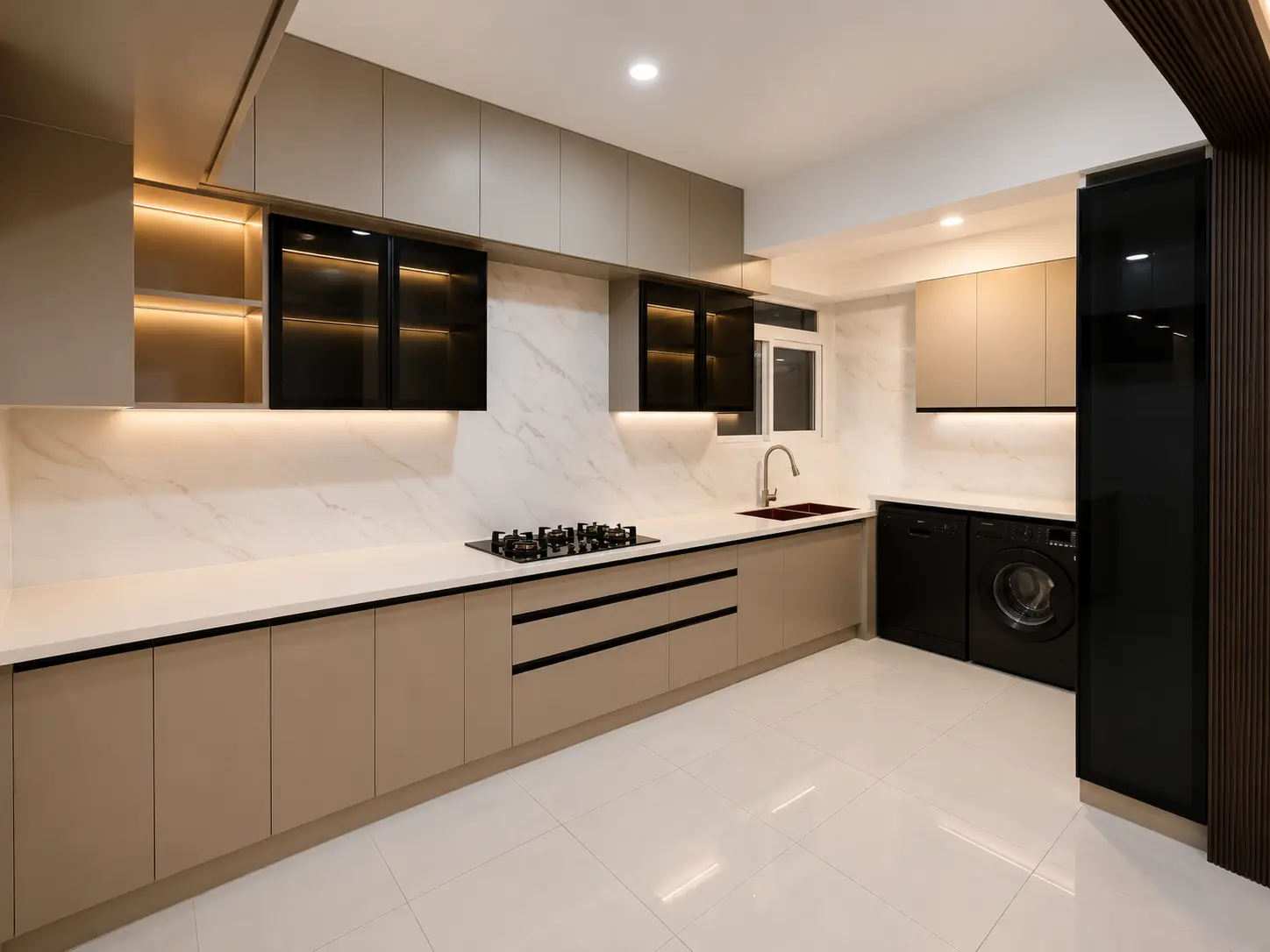
TouchWood integrates chimney placement into the kitchen design from the beginning. The height from stove to chimney hood, the width of the chimney relative to the hob, and how the unit sits within the overhead cabinetry are all planned together. This coordination is what separates a kitchen that looks good from one that also functions well.
Worth reading next: TouchWood's modular kitchen design service, how TouchWood designs kitchens in Bangalore and small kitchen design ideas for Indian homes.
Talk to TouchWood About Designing Your Kitchen
- Phone: +91 97418 67803
- Address: #169, Kannur, Bidarahalli Hobli, Bangalore 560077
- Website: touchwoodstudio.in
Frequently Asked Questions
For regular Indian cooking with tadkas, frying, and pressure cooking, a chimney with at least 1000 to 1200 m³/hr suction is recommended. Lower-capacity chimneys can struggle to keep up with the smoke and grease generated by everyday Indian meals.
For Indian cooking, yes. Ducted chimneys remove smoke and grease from the kitchen entirely, which ductless models cannot fully match. If your kitchen layout allows for ducted installation, that is the better choice. Ductless chimneys are a workable alternative when ducting is not possible.
Baffle filters in a typical Indian kitchen should be cleaned every four to six weeks. Auto-clean chimneys require less frequent attention, as the heating cycle handles grease collection automatically. The collection tray on auto-clean models still needs to be emptied periodically.
Yes. Chimney selection and placement are part of TouchWood's kitchen design process. The goal is to choose a chimney that matches the cooking style and fits correctly within the cabinetry layout, so the kitchen functions well from the start.
The chimney should be at least as wide as the cooking hob, and ideally slightly wider. For a standard four-burner hob, a 90 cm chimney provides better coverage than a 60 cm model and is the more common recommendation for Indian kitchens.